Showing posts with label milky way. Show all posts

Wednesday, October 7, 2009

Gaxaly in Turmiol


The European Space Agency (ESA) has released some new pictures of our Galaxy.  These images come from a test run of the Herschel observatory, which will focus on studying cold material in our galactic plan, and how that material affects planet formation. Apparently these pictures show unexpected signs of activity in the Milky Way.  The universe is in more turmoil then astronomers previously suspected.
"The resulting images reveal an extremely rich reservoir of cold material in the Galactic Plane that is seen to be in a previously unsuspected state of turmoil. Interstellar material appears to be condensing in a continuous and interconnected maze of filaments and strings of newly-forming stars in all stages of development. The observations yield additional information about this cold material - such as how much there is, its mass, temperature and composition, and whether or not some of it is collapsing to form new stars." [ESA]
Thursday, September 17, 2009

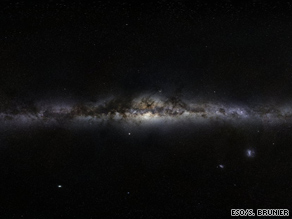
Milky Way panorama

For those who like looking at pictures of space, European Southern Observatory has released an interactive view of the Milky Way.  It's a highly detailed map of our galaxy which shows objects ranging from Jupiter to Messier 35 cluster.

"The image is composed of almost 1,200 photos, which were taken by French astrophotographer Serge Brunier with a regular digital camera from ESO observatories at La Silla and Paranal in Chile and from one of the Canary Islands."

Gigagalaxyzoom.org
CNN article

Sunday, September 6, 2009

Mira


I stumbled upon an interesting article by NASA recently. It's about a star that has left a 13-light year trail of debris. Also called "Johnny Appleseed", the star's wake is being recycled into new celestial objects. Mira (pronounced my-rah) was discovered by the Galaxy Evolution Explorer.

"Mira is a highly evolved, "red giant" star near the end of its life. Technically, it is called an asymptotic giant branch star. It is red in color and bloated; for example, if a red giant were to replace our sun, it would engulf everything out to the orbit of Mars. Our sun will mature into a red giant in about 5 billion years."

The reason why Mira has created such an interesting effect in our night sky is due to it moving faster relative to the ambient gases in the Milky Way. The star is moving at a spead of 130 KM/s.

Thursday, September 3, 2009

Super Galaxy


Well, maybe not a super galaxy, but at least a hungry one. It was reported by the BBC that the Andromeda galaxy has consumed other galaxies in the past. A team of scientists noticed that there were stars in the Andromeda galaxy that shouldn't have been there, and was later reasoned to be remnants of a dwarf galaxy.

The Andromeda galaxy is the same one that is supposed to collide with our own Milky Way in about 3-billion years. It is 2.5 light years from Earth and close enough that we can make the stars in it.

ShareThis